Research project

Signal Steward

From three CSCW papers to one live classroom system.

This project came out of a simple question: if one paper is about what makes a public update useful, another is about how crowds keep shared knowledge good, and a third is about how ties carry reach, trust, and support, can those ideas become one activity people can actually use?

Signal Steward is my answer. Everyone in class joins as a participant. I am the only facilitator. The system turns three short responses into a visible stance card, a live wall, and two balanced debate teams.

Signal Edit Support Live classroom system

Inspired by Prof. Yubo Kou | Developed by Ishan Shivansh Bangroo | Contributor: Nicole Leon

What this project is really doing

Plain English

The point here is not just to summarize papers. The point is to make people act on them. A participant has to decide what a useful update looks like, how a shared page stays reliable, and which ties they would activate first. After that, the system turns those choices into a visible stance and a debate setup. So the reading becomes a live, social decision instead of a slide summary.

The three papers behind Signal Steward

Research grounding

Paper 1 · Signal

Microblogging During Two Natural Hazards Events

Vieweg, Hughes, Starbird, and Palen

This paper looks at Twitter during floods and grassfires. Its core point is that the useful posts are not just fast. They are specific enough to help other people build situational awareness: where something is, what changed, what danger is present, and what people should do next.

In Signal Steward, that becomes the first move. Participants have to write the kind of public update that would actually help another person.

Read the paper
Paper 2 · Edit

Harnessing the Wisdom of Crowds in Wikipedia

Kittur and Kraut

This paper argues that more contributors do not automatically make a shared page better. Quality improves when coordination is present. A crowd helps when the work is structured, responsibilities are clearer, and editing does not collapse into noise.

In Signal Steward, that becomes the second move. Participants have to explain how a shared page should be organized so openness still leads to quality.

Read the paper

Paper 3 · Support

The Benefits of Facebook “Friends”

Ellison, Steinfield, and Lampe

This paper shows that online ties do different jobs. Bridging ties bring reach and new perspectives, bonding ties bring trust and support, and maintained ties help people stay connected across life changes. The strongest pattern in the study is around bridging social capital.

In Signal Steward, that becomes the third move. Participants decide which ties they would activate first and what should stay public or remain bounded to smaller trusted groups.

Read the paper

How the activity is inspired by the papers

From reading to action
01

Signal

Participants write the first public update. The system is looking at whether the response gives concrete, useful signal rather than vague commentary.

02

Edit

Participants explain how a shared page should work when many people want to contribute. This is where coordination, structure, and stewardship come in.

03

Support

Participants decide which ties to activate first and how visible information should be. This is where reach, trust, and bounded sharing start to pull against each other.

04

Debate

The system turns those choices into stance cards and balanced teams, then surfaces the bigger question: when should a system favor openness, and when should it favor tighter coordination and selective visibility?

Live views

What people actually use
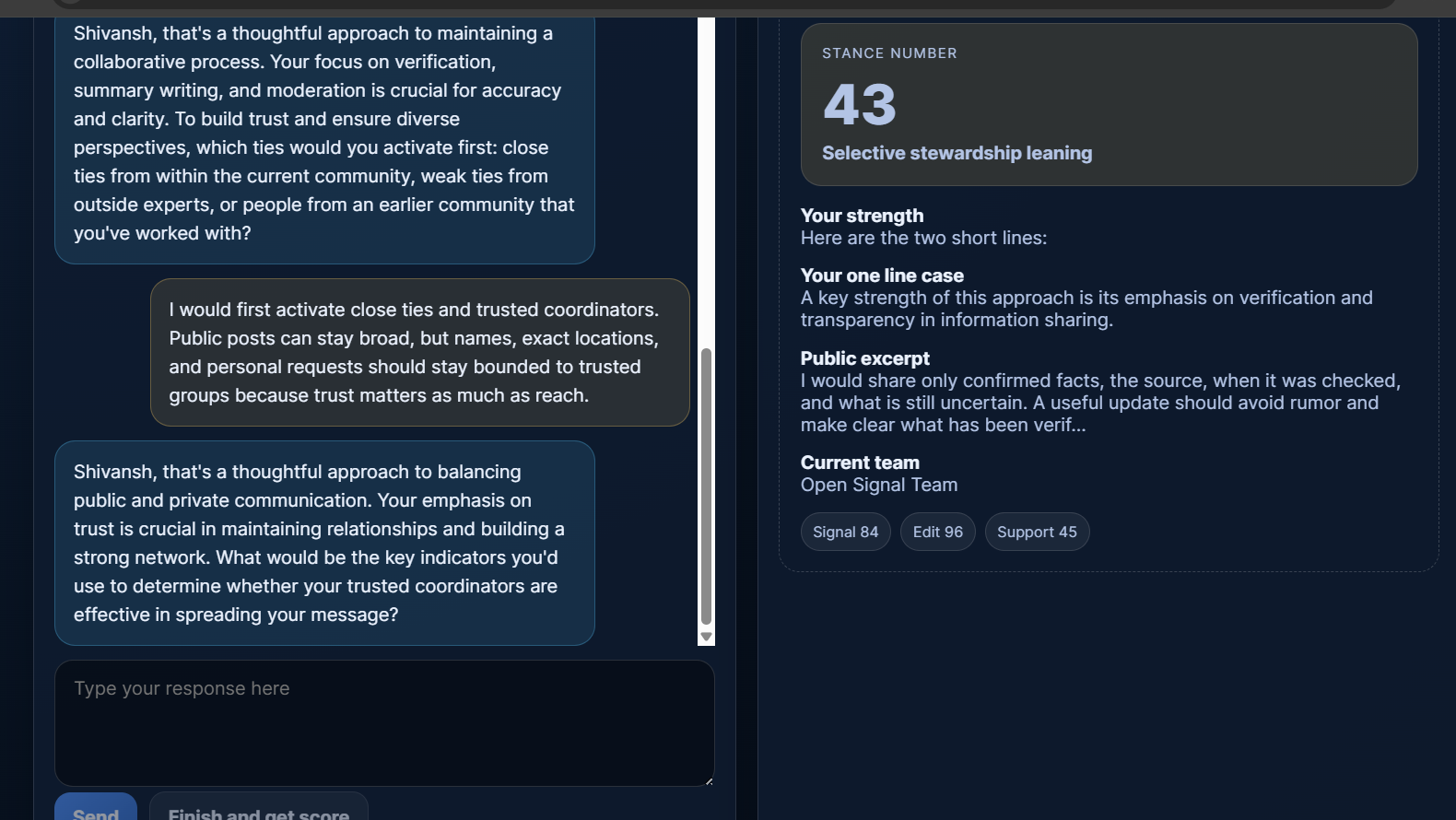
Signal Steward participant view screenshot

Participant view

The page the class joins

A participant enters their name, answers three prompts, gets a stance number, and sees a short public card. This is the page everyone opens during the activity.

Launch participant view
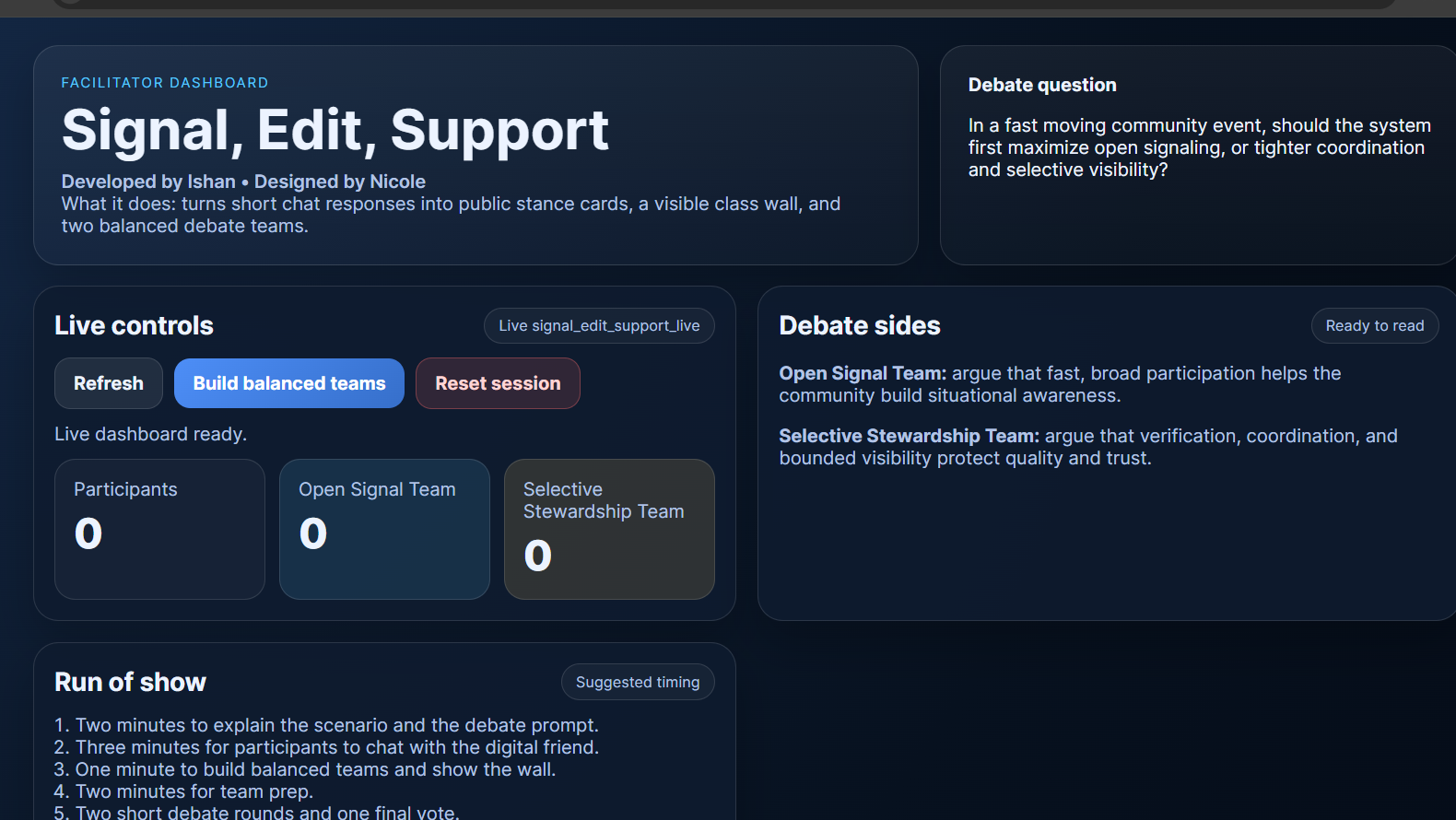
Signal Steward facilitator console screenshot

Facilitator console

The page I use during the activity

This console lets me refresh the session, read the live wall, build balanced teams, and guide the final debate. It is meant for one facilitator, not for the full class.

Launch facilitator console